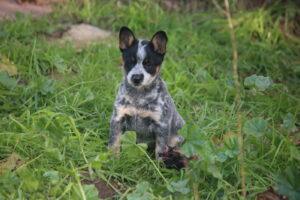
A Mini Heeler dog is a smaller version of a full-size heeler. Blue Heelers, Red Heelers, and Queensland Heelers are all common names for Australian Cattle Dogs.
Breed standard for full-size Australian Cattle Dogs, measured to top of shoulder, are as follows: Males are 18-20” tall, and Females are 17-19”.
Mini Australian Cattle Dogs measure anything under 17” and there is no weight limit.
They have a muscular build and a sturdy frame, making them an excellent working dog. Their compact medium size makes them perfect for going everywhere with you. Australian Cattle Dogs are also known for their erect triangular ears and almond shaped intelligent eyes.
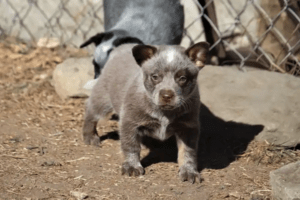
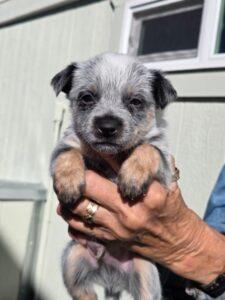
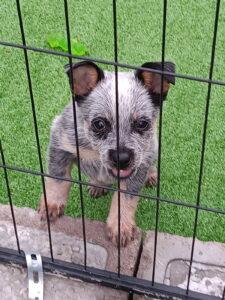
Blue Heelers have a short, smooth coat that is blue or blue-mottled with black masks and few body spots, and some have tan markings on their chest and legs. Red Heelers are red-speckled, or mottled with darker red masks and body spots.
Bentley Star
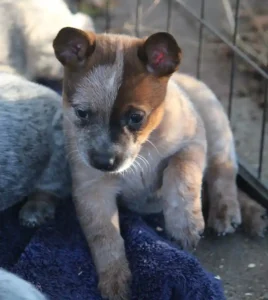
One of the most common physical characteristics Queensland Heelers are known for is the “Bentley Star” or “Bentley Mark,” a patch of white hair on the forehead that can be found in both red and Blue Heelers. The size of this patch can vary, ranging from just a few hairs to a larger spot. It’s important to note that the absence of the Bentley Star is not considered a flaw.
Legend has it that the Bentley Star is linked to a dog owned by a Mr. Tom Bentley, who was renowned for his exceptional breeding qualities. In addition to the white blaze on the forehead, the occasional black spot at the base of the tail in blue dogs is also believed to be a characteristic of Bentley’s dog.
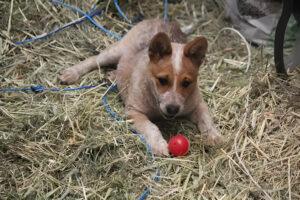 The Mini Heeler, like Australian Cattle Dogs as a whole, is more than just an intelligent and energetic breed. They are loyal, hardworking companions with a strong desire to please their owners.
Highly regarded for their agility, endurance, and work ethic, Australian Cattle Dogs are courageous, determined, independent, and strong. Heelers are especially known for being highly trainable and are commonly used as working dogs for ranching and herding, where their focus and reliability truly shine.
Beyond the ranch, Mini Heelers make excellent family pets. They are deeply loyal, affectionate, and known for their confident, engaging personalities. With proper socialization and training, they are gentle and patient with children, making them a great choice for active families.
Note: As natural herding dogs, Heelers may instinctively try to herd or “round up” young children. Early training and consistent guidance are important to manage this behavior and ensure a positive, well-balanced family environment.
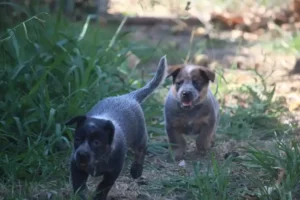 The Mini Heeler is a high-energy, intelligent breed that thrives on daily physical and mental challenges. They love hiking, jogging, biking, and playing fetch—and can even romp alongside horses on trail rides, making them ideal companions for active families.
Dog Sports & Training: Mini Heelers excel in agility, herding trials, flyball, frisbee, rally, and obedience. These activities provide an excellent outlet for their energy while keeping them focused and motivated.
The Mini Heeler is a high-energy, intelligent breed that thrives on daily physical and mental challenges. They love hiking, jogging, biking, and playing fetch—and can even romp alongside horses on trail rides, making them ideal companions for active families.
Dog Sports & Training: Mini Heelers excel in agility, herding trials, flyball, frisbee, rally, and obedience. These activities provide an excellent outlet for their energy while keeping them focused and motivated. 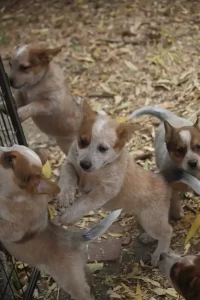 Mental Stimulation: Puzzles, interactive games, and training sessions are essential for keeping their minds sharp. A mentally engaged Mini Heeler is confident, happy, and less likely to develop behavior problems.
Beware of Boredom: Without enough physical and mental activity, Mini Heelers may create their own entertainment—sometimes targeting furniture, trash, lawns, or gardens.
With consistent exercise, training, and enrichment, Mini Heelers are not only well-behaved—they’re lively, loyal, and endlessly rewarding companions for owners who love an active lifestyle.
Health & Genetic Testing
The Australian Cattle Dog is generally a healthy and hardy breed; however, like all breeds, they can be prone to certain inherited health conditions. Responsible breeders, such as EFR Mini Heelers, are aware of these risks and take proactive steps to reduce them through careful breeding and genetic testing.
Some of the more common health concerns in Australian Cattle Dogs include hip dysplasia, eye conditions such as Primary Lens Luxation (PLL) and Progressive Retinal Atrophy (PRA), degenerative myelopathy, and congenital deafness. Many of these conditions are inherited genetic disorders and can be tested for prior to breeding to significantly reduce the likelihood of producing affected puppies.
Choosing a Heeler breeder who performs comprehensive genetic disease panel testing and understands how to interpret the results is essential. In Mini Heelers, there are 10 primary genetic diseases that should be screened. Eight of these conditions are inherited in an autosomal recessive manner, meaning a puppy must inherit two copies of the mutated gene—one from each parent—to develop the disease. Dogs with only one copy are considered carriers and typically show no symptoms. However, breeding two carriers together carries a risk of producing affected puppies.
When two carrier dogs are bred, each puppy has a 25% chance of being affected, a 50% chance of becoming a carrier, and a 25% chance of inheriting no mutation at all. For this reason, breeding two known carriers of the same mutation is not recommended. Dogs that are clear of the mutation do not have an increased risk of producing affected offspring.
Autosomal Dominant & Incomplete Dominant Conditions
The remaining two genetic conditions seen in Australian Cattle Dogs are inherited differently:
- Cystinuria (ACD type) is inherited in an autosomal dominant manner. Dogs need only one copy of the mutated gene to develop the condition. Affected dogs may show mild or no symptoms initially, but each puppy from an affected parent has a 50% chance of inheriting the mutation. Breeding affected dogs is not recommended to prevent passing the condition on.
- Primary Lens Luxation (PLL) is inherited in an autosomal incomplete dominant manner. Dogs with one copy of the mutation are considered at increased risk, while those with two copies are at the highest risk. Because symptoms may not appear until adulthood, genetic testing prior to breeding is essential.
Through responsible genetic testing and informed breeding decisions, these conditions can be significantly reduced or eliminated from breeding lines.
Coat & Grooming
The Blue Heeler, Red Heeler, and Queensland Heeler have a short, double coat that is easy to maintain and requires minimal grooming. Regular brushing helps remove loose hair, keeping the coat healthy and sleek. Baths are only necessary on occasion, such as after heavy dirt or mud exposure.
Some Australian Cattle Dogs love water and will happily jump into troughs, rivers, lakes, or even the ocean. Others are less enthusiastic and may not enjoy bath time as much. Individual preferences vary, but overall grooming needs for the breed are simple and manageable.